

[ad_1]
Editor’s Note: In the storm’s path? Bookmark CNN’s lite site for fast connectivity on low bandwidth.
CNN
—
A vicious storm that smacked the central and eastern US Friday is continuing its assault Saturday with whipping winds and blizzard conditions, rain, snow and dangerous coastal flooding. Meanwhile, a brutal blast of Arctic air is spreading south and east through the central US and will bring snow and ice to the South. Here’s the latest.
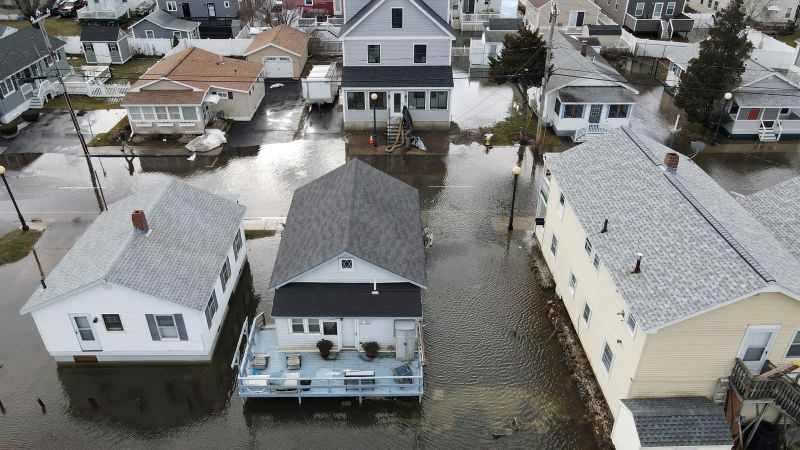
Historic storm surge hits Maine: Water levels on Maine’s coast hit a historic high on Saturday, inundating coastal communities already swamped by record-breaking surges on Wednesday.
Flash flood warnings were issued by the National Weather Service in Gray, Maine, as the storm’s strong winds blew water from the Atlantic Ocean toward the shore on top of high tide Saturday morning and combined with falling rain to create a dangerous situation.
The water level in Portland hit 14.57 feet just after noon, higher than the 13.84 feet hit on Wednesday, and higher than the previous record set in 1978, National Weather Service data shows.
Portland Police Department
Cars sit in floodwaters caused by high tides in Portland, Maine, on Saturday, January 13, 2024.
Portland police said on X that there were “too many” roads closed to list because of the flooding. Roads were also closed in coastal New Hampshire as water levels rose there, according to the state’s department of transportation.
Moderate coastal flooding was also reported in New Jersey, New York, Connecticut, Massachusetts and Rhode Island, NOAA data shows.
Coastal flood alerts remain in effect for several spots throughout the day Saturday for lingering flooding, with most set to expire by the end of the day.
Buffalo Bills playoff game postponed: The scheduled game between the Bills and Pittsburgh Steelers in Buffalo was moved from Sunday at 1 p.m. to Monday at 4:30 p.m. because of the “dangerous conditions,” New York Gov. Kathy Hochul said on X Saturday.
Gary Hershorn/Corbis News/Getty Images
Water from the Hudson River overflowed a river wall on January 13, 2024, in Jersey City, New Jersey.
Strong winds from the storm blowing across an exceptionally warm, ice-free Lake Erie will produce heavy lake-effect snow through Monday morning. One to 3 feet of snow could fall, with the highest totals coming where the bands of snow persist the longest.
“Winds gusting as high as 65 mph early in the event will diminish somewhat late Saturday night. Blizzard conditions will be possible at times, especially Saturday night and Sunday,” the weather service in Buffalo said.
In Erie County, New York, which includes Buffalo, officials have declared a state of emergency starting Saturday due to the incoming storm and snow, county executive Mark Poloncarz announced.
A travel ban was also set to go into effect at 9 p.m. ET Saturday for Erie County to help crews clear the roads given the intense snowfall to come.
Strong winds buffet Northwest: Falling trees have toppled power lines, started fires and shut down transit in Portland, Oregon, as high winds and frigid conditions kept emergency workers busy Saturday. Portland Fire and Rescue reported multiple fires in the community started by fallen trees and power lines.
The National Weather Service in Portland reported winds around 30 mph and subzero wind chills Saturday evening.
The city’s transit system announced its rail transit service would be closed Saturday because of the weather.
More than 550,000 homes and businesses in the dark: Widespread power outages stretched from the Great Lakes to the South Saturday after intense winds, severe thunderstorms and heavy snow walloped several states.
More than 230,000 customers are without power in Oregon, and another 11,000 in Washington.
Strong winds on the back side of the storm caused power outages to climb throughout the morning in the Great Lakes. As of 7 p.m. ET, Michigan had the second-most utility customers without power – more than 104,000, followed by more than 63,000 customers cut off in Wisconsin.
Brendan McDermid/Reuters
A snowy, cold scene in Des Moines, Iowa, on January 13, 2024.
Iowa is the epicenter for blizzard conditions and cold: Most of Iowa was under a blizzard warning Saturday as 6 to 10 inches of previous snowfall was whipped up by wind gusts of more than 40 mph. Back-to-back storms hammering the Midwest have resulted in the snowiest week for Des Moines since 1942.
The Iowa State Patrol responded to 535 motorist assist calls and 86 crashes by Saturday afternoon as whiteout conditions pounded the state, the agency said in a social media post.
Bone-chilling cold began to envelop the state and is expected to make for the coldest Iowa caucuses on record Monday. Wind chills as low as minus 45 degrees were forecast by Sunday morning, cold enough to cause frostbite on exposed skin in as little as 10 minutes.
Gary Hershorn/Corbis News/Getty Images
Water from the Hudson River overflows from river wall at high tide as a woman jogs in Jersey City, New Jersey, on Saturday, January 13.
Brendan McDermid/Reuters
Snow and ice dust a worker as they remove snow from a sidewalk in Des Moines, Iowa, on Saturday.
Joseph Prezioso/AFP/Getty Images
Storm waves batter coastal homes as the tide rises in Winthrop, Massachusetts, on Saturday.
Al Drago/Bloomberg/Getty Images
A pedestrian walks through snow during a winter storm ahead of the Iowa caucus in Des Moines, Iowa, on Friday, January 12.
Jim Vondruska/Getty Images
Travelers check their flight status at O’Hare Airport on Friday in Chicago. More than 2,000 flights have been canceled nationwide due to a large winter storm bringing blizzard conditions.
Eric Seals/USA Today
Vehicles slowly make their way on Northwestern Highway on Friday in Farmington Hills, Michigan.
Andrew Harnik/AP
Workers shovel sidewalks in Ankeny, Iowa, on Friday. The vast majority of Iowa was under a blizzard warning Friday.
Carolyn Kaster/AP
Snow blows over a county road near Merrill, Iowa, on Friday.
Antonio Perez/Chicago Tribune/TNS/Zuma
Rebecca Zimmerman walks beside her bicycle on her way to work in Oak Park, Illinois, on Friday.
Erin Hooley/AP
Snow falls as migrants continue to be housed by the city in “warming” buses in Chicago on Friday.
Sam Wolfe/Reuters
A man looks over a heavily damaged oak-barrel factory in Bamberg, South Carolina, on Wednesday, a day after a tornado struck the city.
Bryan Woolston/AP
An employee of the Storm Bros. Ice Cream begins to clean up Wednesday after the storm left more than 2 feet of water inside many businesses in downtown Annapolis, Maryland.
Dan Powers/USA Today Network
Snowy weather on Tuesday caused slippery conditions along Interstate 41 in Appleton, Wisconsin.
Dan Powers/USA Today Network
Kelly-Jo St. Aubin clears snow from the sidewalk outside her home in Kaukauna, Wisconsin, on Tuesday.
Peter Zay/Anadolu/Getty Images
Firefighters rescue a man after his car was stuck in a flooded area in Charlotte, North Carolina, on Tuesday.
Spencer Platt/Getty Images
Because of the storm, nearly 2,000 migrants in Brooklyn, New York, were evacuated from tents at Floyd Bennett Field and taken to a local high school on Tuesday.
Scott Olson/Getty Images
A pedestrian navigates a snow-covered sidewalk in Iowa City, Iowa, on Tuesday.
Gregg Pachkowski/USA Today Network
Linda Cox looks at her two vehicles that were damaged by a fallen tree in Myrtle Grove, Florida.
Jaide Garcia/CNN
A house is damaged in Panama City Beach, Florida, on Tuesday. Responders rescued people from structures in Florida’s Bay County, where multiple tornadoes hit the ground and caused significant damage and road closures, Bay County Sheriff Tommy Ford said.
Timothy A. Clary/AFP/Getty Images
People carry umbrellas in New York’s Times Square on Tuesday.
Mike De Sisti/The Milwaukee Journal/USA Today Network
Snow covers the trees around the Holy Hill Basilica and National Shrine of Mary in Hubertus, Wisconsin, on Tuesday.
Joe Raedle/Getty Images
People in Des Moines help push a vehicle back onto the road after it became stuck in the snow on Tuesday.
Mckenzie Lange/USA Today Network
A man braves the rain Tuesday while taking videos of the Reedy River’s rushing water in Greenville, South Carolina.
Tariq Zehawi/NorthJersey.com/USA Today Network
Workers Brian Henderson and Josko Huljev fill sandbags for residents of Totowa, New Jersey, on Tuesday. New Jersey Gov. Phil Murphy announced a state of emergency to prepare for the potentially dangerous weather.
SCV/Michael Gordon
Tornado wreckage is seen in Bay County, Florida, on Tuesday. Twelve tornadoes were reported across Florida, Alabama and Georgia on Tuesday morning.
Alex Hicks Jr./Spartanburg Herald-Journal/USA Today Network
Flooding is seen at an intersection in Spartanburg, South Carolina, on Tuesday.
Will Lanzoni/CNN
Snow blankets the ground in Des Moines on Tuesday.
Joe Raedle/Getty Images
A person in Iowa City uses a snowblower to clear a sidewalk on Tuesday.
Chip Somodevilla/Getty Images
A light and steady snow falls on the Iowa State Capitol on Monday.
Freezing cold for 75% of the US: It’s not just Iowa, 75% of the country will experience temperatures below freezing over the next 7 days as a potent blast of Arctic air plunges south.
Fifty-five million of them will endure temperatures below zero. The temperatures will feel even colder when coupled with wind. A wind chill of minus 71 degrees was recorded in Navajo, Montana, Saturday morning.
Bitter cold tees up South snow and ice: Temperatures well below average will fully envelop the South and parts of the Southeast by Tuesday.
A new storm system will track through the cold air and start to put out snow, sleet and ice as soon as Sunday afternoon in parts of Oklahoma and Texas.
Any wintry precipitation that falls Sunday will hang around on untreated surfaces because of the cold, making for a potentially treacherous Monday morning commute in places like Dallas.
The system will then leave a shot of modest snow from west to east across Arkansas, northern Louisiana, Mississippi and Alabama and into Tennessee. Points to the south are more likely to see ice than snow.
View this interactive content on CNN.com
Arkansas looks set to receive some of the most snow from the event. Six inches or more could fall in parts of the state. Arkansas Gov. Sarah Huckabee Sanders declared a state of emergency Friday ahead of the bitter cold and snow.
Louisiana Gov. Jeff Landry announced a state of emergency in effect from Sunday through Wednesday for the storm and cold as well.
CNN’s Eric Zerkel, Taylor Ward, Mary Gilbert, Allison Chinchar, Holly Yan, Robert Shackelford, Dave Alsup, Joe Sutton, Sara Smart, Zenebou Sylla, Artemis Moshtaghian and Nicole Grether contributed to this report.
[ad_2]
Source link
